

Business Process Management
Designing and orchestrating business processes
Our teams have extensive experience in designing and developing Business Process Management (BPM) solutions for the digitalization and automation of business processes.
BPM platforms enable organizations to model, automate, and monitor processes by integrating people, information systems, and data into a single operational flow.
Through these solutions, companies can:
- eliminate manual and redundant activities
- improve process visibility
- reduce execution times
- integrate different business applications within structured workflows
The experience gained from working with both enterprise organizations and SMEs allows us to support clients from process analysis through to solution implementation, designing systems that truly align with the organization and its operational context.
BPM platforms also represent an effective tool for enabling paperless processes, by digitalizing forms, documents, and approvals, and integrating them with document management systems, electronic signatures, and business applications.
BPM and AI agent orchestration
In recent years, Business Process Management has been rapidly evolving thanks to the introduction of artificial intelligence.
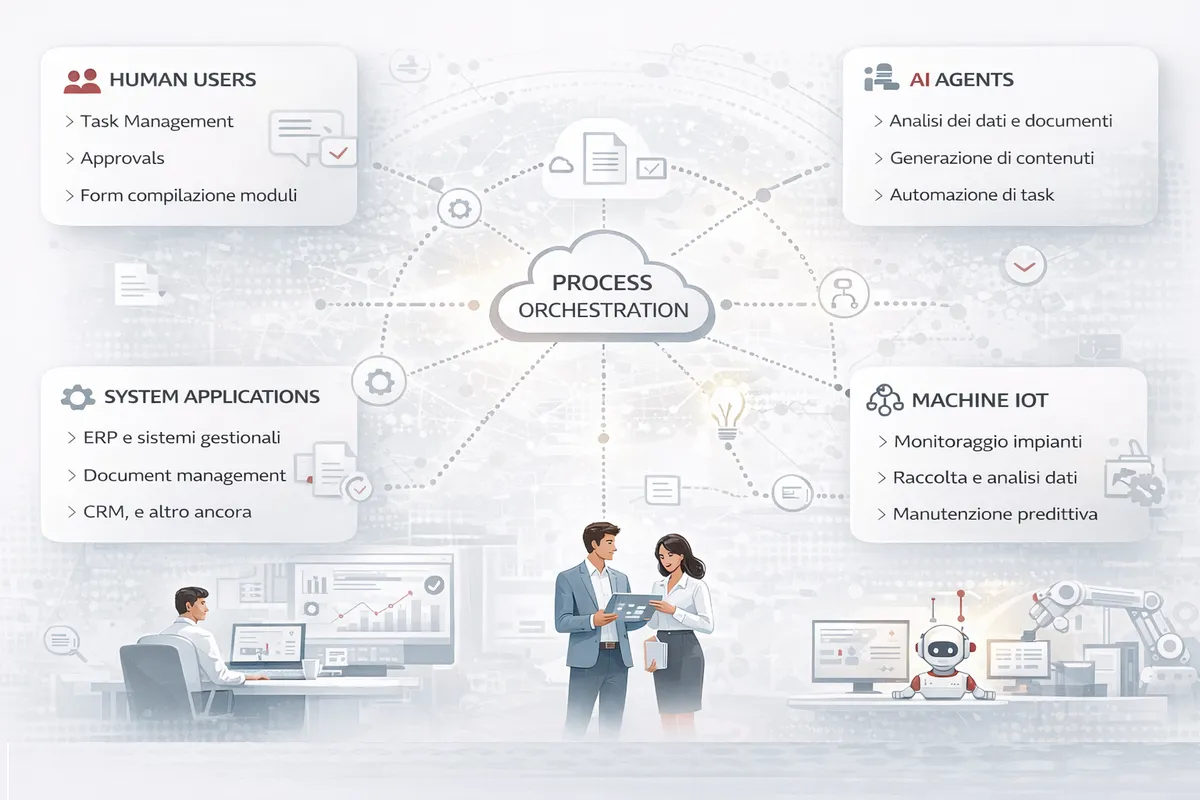
While BPM platforms traditionally coordinated people and application systems, they are increasingly becoming tools for orchestrating AI agents, capable of automating analysis, content generation, and decision support activities.
In this scenario, a process is no longer just a sequence of tasks, but becomes an intelligent system where:
- human users
- application systems
- artificial intelligence services
collaborate within the same workflow.
BPM thus becomes the meeting point between business processes, automation, and artificial intelligence, enabling organizations to introduce new forms of digital collaboration.
Speed of development and low-code approach
Modern BPM platforms allow for rapid development of process applications thanks to low-code environments and visual modeling tools.
Through standards such as BPMN 2.0, business processes can be represented in a clear and understandable way—even for business users—while maintaining a direct link to the technical implementation.
This approach enables organizations to:
- design and release new process applications quickly
- document and improve business workflows
- easily adapt solutions to organizational changes
Integration with enterprise systems
One of the main strengths of BPM platforms is their ability to integrate existing systems and applications.
The solutions we develop can connect with:
- ERP and management systems
- document management systems
- cloud platforms and API services
- collaboration and productivity tools
In this way, BPM becomes the orchestration layer that connects different business systems, improving information flow and reducing operational silos.
ProcessMaker

Bitia is an Elite Partner of ProcessMaker, one of the leading low-code BPM platforms used for business process automation.
ProcessMaker enables the design of complex workflows through a visual BPMN modeler and the development of process applications integrated with enterprise systems.
The platform includes advanced features for:
- process modeling
- task and approval management
- development of dynamic forms and operational dashboards
- integration with ERP, CRM, and external services via APIs
ProcessMaker has introduced several AI-powered features, enabling:
- automatic analysis of documents and data
- decision suggestions in approval processes
- automatic generation of content and process tasks
- user support in managing operational activities
These capabilities transform the platform into an environment where workflows, data, and AI collaborate to improve operational efficiency.
ClickUp
Bitia is a partner of ClickUp, a modern platform for work management, project management, and collaborative processes.
ClickUp originated as a project management tool, combining task management, documentation, automation, and configurable dashboards for different team functions.
The platform now includes advanced AI features that support users in their daily activities:
- automatic generation of documents and content
- summarization and analysis of information
- assistance in managing tasks and projects
- support for planning and team productivity
Thanks to its flexibility, ClickUp can be used both as a collaboration tool and as an environment to orchestrate operational workflows and business processes.
Towards a new digital collaboration
The evolution of BPM platforms and collaborative work tools is transforming the way organizations operate.
In the past, digital processes mainly coordinated people and information systems. Today, the most advanced platforms introduce a new paradigm:
collaboration between people, applications, and artificial intelligence.
In this scenario, the role of Business Process Management platforms is to orchestrate this collaboration, creating intelligent processes capable of adapting, learning, and supporting operational decisions.
The modern digital enterprise is therefore evolving from a human–machine collaboration model to a human–machine–AI model, where processes, data, and artificial intelligence work together to improve efficiency, quality, and decision-making speed.